There is a lot of talk these days about “off-grid stays” and “tiny homes”. The phrases are used widely, sometimes loosely, and often without much explanation. Some off-grid cabins are thoughtfully designed and engineered for real environmental performance. Others are little more than a shed in a paddock dressed up with clever marketing.
So what does off-grid actually mean at Kimo Estate? And why has it worked so well here?
At its core, off-grid means independence. Our ecohuts operate entirely without connection to town power or mains water infrastructure. They are powered by solar energy, supported by battery storage systems, and supplied by harvested rainwater. Heating is achieved through efficient wood combustion, and the structures themselves are designed for passive thermal performance. What off-grid does not mean is cold showers, discomfort, or sacrifice. It does not mean “roughing it” or giving up modern convenience. The purpose of our ecohuts was never to strip away comfort, but to prove that comfort can be achieved intelligently and responsibly.
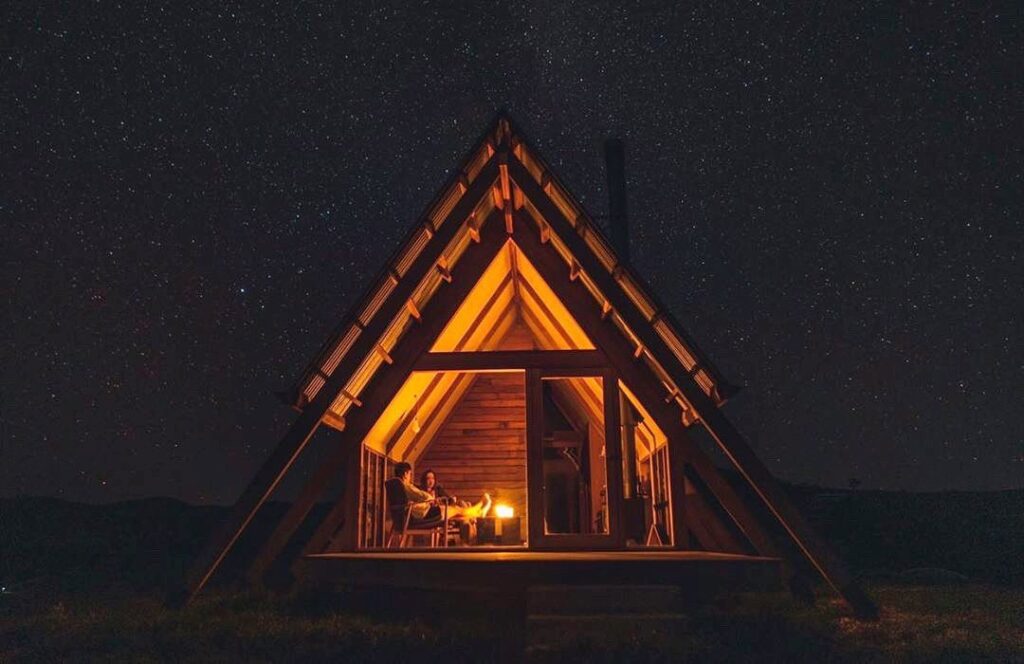
The design of the huts is central to that philosophy. These are not improvised structures or repurposed containers dropped into the landscape. JR’s Hut in particular has received significant architectural attention because every element was considered carefully. Orientation, window placement, roof pitch, material choice and insulation all play a role in how the hut performs across seasons. When people discuss tiny homes, the focus often centres on size. For us, the focus has always been on design intelligence. A smaller footprint demands greater thought, not less.
Australian conditions also demand respect.
An off-grid structure in Scandinavia is designed for very different environmental pressures than one in Gundagai. Our ecohuts are built to withstand intense summer heat, frosty winters, strong winds and prolonged dry periods. Thermal mass, ventilation, shading and insulation were not aesthetic decisions; they were practical necessities. Over the years we have hosted thousands of guests through all seasons. The design has been tested in reality, not just imagined on paper.
Sustainability at Kimo Estate is also practical rather than performative. In an era where “green” has become a marketing term, we are careful to ensure that our claims reflect genuine operational practice. Solar genuinely powers the huts. Rainwater genuinely supplies them. Waste systems are responsibly managed. Our tree planting programs actively regenerate sections of the farm. As a 6,500-acre working property, environmental stewardship is not optional. If the land fails, we fail. Off-grid design is not a trend here; it is a logical extension of how we manage our landscape.
The idea of luxury has also shifted in recent years.
It no longer revolves solely around excess. Increasingly, luxury is defined by space, silence and privacy. It is defined by watching the light change across rolling hills, soaking in a wood-fired hot tub under a sky full of stars, and hearing nothing but wind in the trees. Our ecohuts are modest in physical size, yet expansive in experience. Their small footprint allows the surrounding landscape to take centre stage.
Understandably, guests sometimes arrive with questions. Is it comfortable? Is it reliable? What happens if the power runs out? The reality is that modern off-grid systems, when designed correctly, are highly dependable. Solar technology is mature and efficient. Battery storage systems are stable. Water storage is monitored and managed carefully. Tiny homes are no longer experimental concepts; they are proven, resilient solutions. In a climate like Australia’s, resilience is becoming increasingly important.
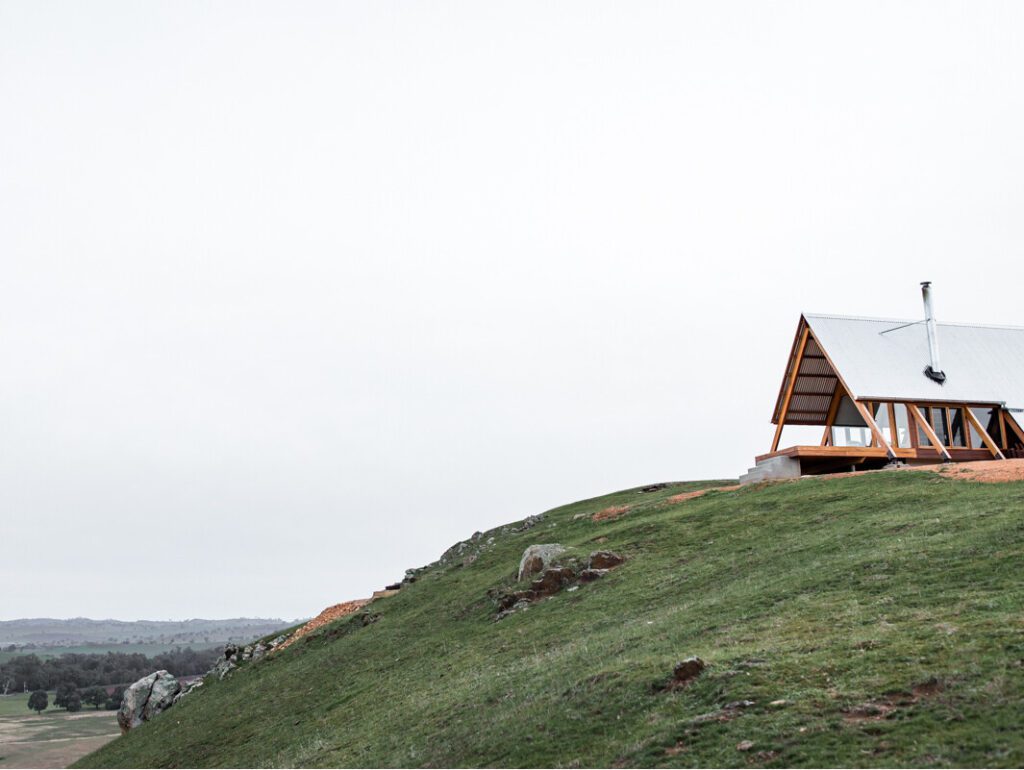
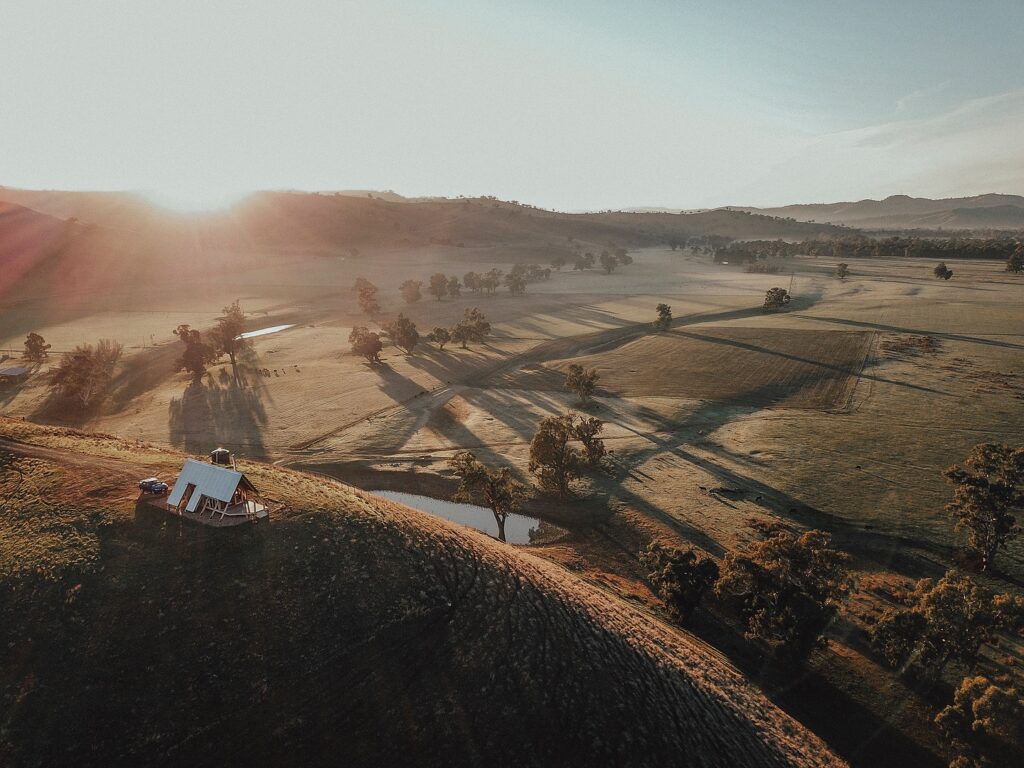
Location is equally critical. An ecohut placed in suburbia misses the point. Ours sit on private hilltops overlooking working farmland near Gundagai in regional New South Wales. The architecture is intended to enhance the land rather than dominate it. Off-grid design only makes sense when paired with open space, environmental integrity and genuine seclusion. That context is what gives the experience authenticity.
We did not build the ecohuts to follow a trend.
They were created because they made sense for our landscape, our farming operation and our long-term philosophy. Years later they continue to operate efficiently, comfortably and sustainably. That longevity is perhaps the strongest evidence of all.
Off-grid at Kimo Estate means architect-designed, solar powered, rainwater supplied, thermally efficient and environmentally responsible accommodation. It means genuine privacy and connection to the land. It means a small footprint paired with a large experience.
Tiny in scale, expansive in impact — and built to last.